


In her deeply personal debut film, Melbourne-based filmmaker Benu Bindra turns the hidden struggles of migrant women into a powerful story of courage, survival and hope.
When Graveyard Shift premiered on the closing night of the Indian Film Festival of Melbourne (IFFM2026), Benu Bindra felt excitement, pride and nervousness, but above all, relief.
The ten-minute short film took almost two years to reach the screen. Bindra wrote and directed it while also playing one of its central characters. With no formal training in screenwriting, directing or acting, it marked an extraordinary leap into the unknown.
“I still have to pinch myself,” she says. “I never imagined I would become a filmmaker.”
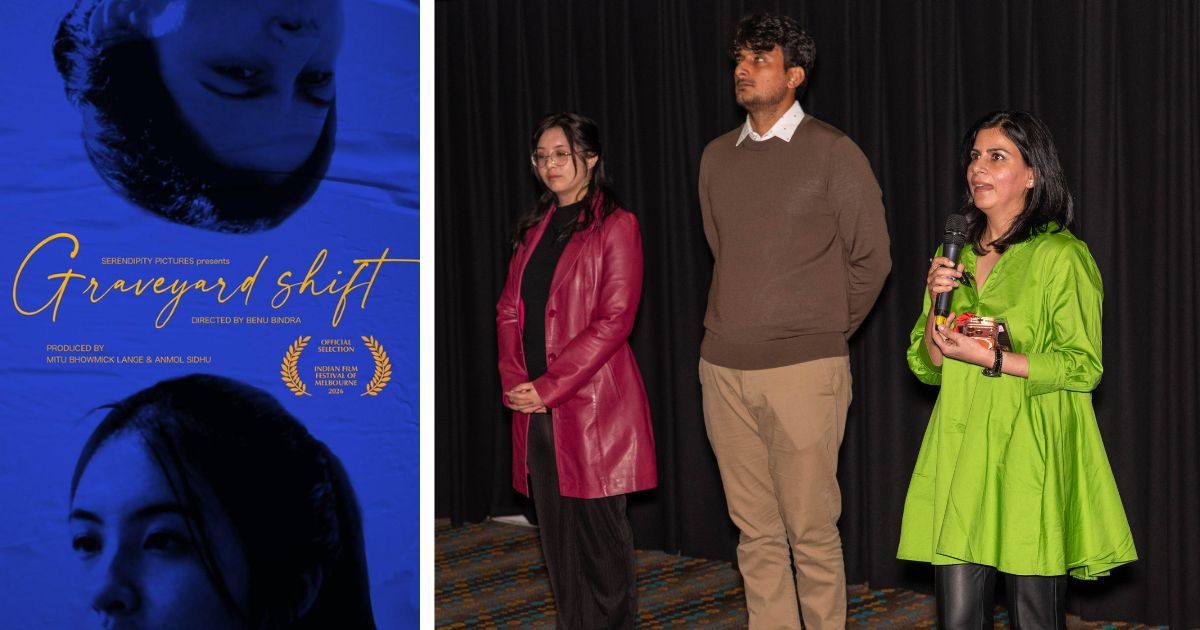
Bindra moved from Amritsar to Melbourne almost 18 years ago as an international student. Today, she works in cybersecurity with the Victorian Government and is raising her two-year-old son as a single mother.
Growing up in a conservative Punjabi family, Bindra loved dancing and dreamed of becoming an actor. Her father was uncomfortable with her entering show business, but she now recognises that his resistance came from a desire to protect his daughters. He died in a road accident soon after she moved to Melbourne and never witnessed this chapter of her life.
Inspired by true events, Graveyard Shift follows two migrant women facing different forms of isolation. One is an international student struggling with grief and the pressures of life overseas. The other appears to have a secure home, marriage and career, but behind closed doors is trapped in an abusive relationship.
“On paper, every box seems to be ticked,” Bindra says. “But underneath, there is so much more happening.”
Drawing from her own experiences and situations affecting people close to her, Bindra made one character Indian and the other Filipino to show that abuse is not confined to one culture or community.
The film unfolds without dialogue, relying on images, sound and performance. Bindra believed spoken words could over-explain the women’s experiences and restrict the audience’s interpretation.
“Film is a visual medium,” she says. “If we can tell the story through images, then dialogue is not always necessary.”
Produced independently without funding, the film demanded persistence. Casting was difficult, with some performers reluctant to be associated with its confronting subject matter. Bindra eventually stepped into one of the roles herself.
Above all, Graveyard Shift is intended to offer hope. Bindra wants those experiencing abuse to understand they do not deserve it and that the cycle can be broken.
Now developing a feature film about a migrant family in Melbourne, Bindra is ready to continue telling stories inspired by the city she calls her second home. Her debut explores life’s darkest hours, but its final message is unmistakably one of light.
Tonee Sethi
